|
E-Motion Newsletter Common Types of Heidenhain Rotary Encoders Used in Robotics, March 2026
Company News – March 2026
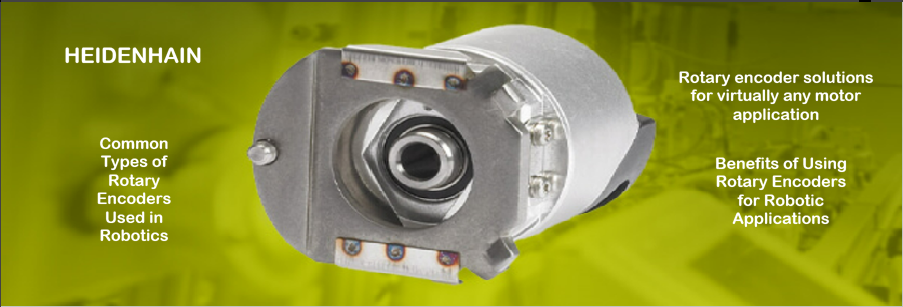
 Benefits of Using Rotary Encoders for Robotic Applications:Rotary encoders enable precise position feedback in robotic systems, allowing accurate control of the tool center point for machining and handling tasks. In dual-loop setups, secondary encoders placed after gear trains help compensate for backlash and mechanical errors, improving overall positioning accuracy. Encoders also provide velocity feedback for smooth acceleration control via servo systems, ensuring repeatable motion. Robust designs—such as inductive encoders from manufacturers like HEIDENHAIN—offer better resistance to vibration and electromagnetic interference. Continuous feedback from encoders is essential for coordinated multi-axis motion and maintaining precision across all robot joints. Common Types of Rotary Encoders Used in Robotics:Solid-shaft encoders attach directly to a rotating shaft and use a sensor to detect position and speed. They come in absolute (unique position values) and incremental (pulse-based movement tracking) types. Hollow-shaft encoders feature a central bore that allows direct mounting onto the shaft, eliminating couplings. This reduces size, avoids backlash, and makes them ideal for space-constrained robotic joints. Dual encoders use two measurement systems on the same shaft—one for absolute position and one for relative motion—providing enhanced feedback and improved accuracy. Examples include models from HEIDENHAIN. General Criteria for Robotics:When selecting an encoder, consider the application requirements, including accuracy and task demands. Evaluate total cost—not just upfront price, but long-term value from performance and reliability. The operating environment (vibration, dust, temperature, EMI) determines the required robustness and sensing technology. Space constraints are critical, especially in multi-encoder setups, so compact designs may be necessary. Flexibility in form factors or modular designs helps meet geometric constraints. Ease of assembly can reduce overall production costs, while safety-rated encoders (e.g., SIL/PL compliant) and reliable interfaces improve system safety and integration efficiency.
For more information, please contact us 
|