|
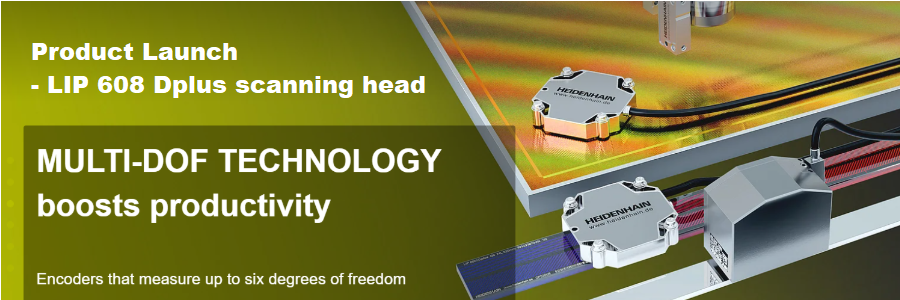
E-Motion Newsletter Product Launch - HEIDENHAIN LIP 608 Dplus scanning head, January 2026
Company News – January 2026
 Multi-dimensional measurement technology Multi-dimensional measurement technologyConventional encoders can measure only one degree of freedom, rendering them blind to unavoidable errors in other directions. In multi-axis systems, an error in one axis carries over into the other axes, thereby affecting the entire motion system. Error in the first axis changes the actual position of the second encoder, and so on. Yet these errors are not normally measured. The Dplus encoders from HEIDENHAIN, however, can measure multiple degrees of freedom on a single axis, allowing the error in one axis to be measured and compensated for in the next. The challenge of perfecting position measurement in the primary axis is significant. Simply optimizing the scale and scanning head is not sufficient for maximizing a motion system’s precision and dynamic performance. Machine design factors and thermal changes play agreater role as accuracy and dynamic-performance requirements increase. Thanks to multi-dimensional encoders such as the LIP 6000 Dplus, these factors can be directly measured and compensated for. Precise measurement for optimal performanceThe interferential measuring principle generates signals by utilizing the refraction and interference of light on finely divided gratings. The measuring standard consists of a flat surface with 0.2 μm-high reflecting lines. These lines are read by a scanning reticle featuring a light-permeable phase grating with an identical graduation period. Interferential encoders use signal periods of 4 μm or less, and these largely harmonicsfree scanning signals can be highly interpolated. Consequently, these encoders are ideal when high resolution and accuracy are required. The Dplus encoders, such as the LIP 6000 Dplus, have a carrier with two separate graduation tracks featuring diagonal graduations (±45°), thus permitting direct, highaccuracy measurement of the primary and secondary directions along the entire measuring length. HEIDENHAIN also offers an incremental two-coordinate encoder for equal measurement in two different directions. Neither direction is primary or secondary. In this case, the carrier is itself a high-accuracy grid graduation. One encoder, multiple degrees of freedom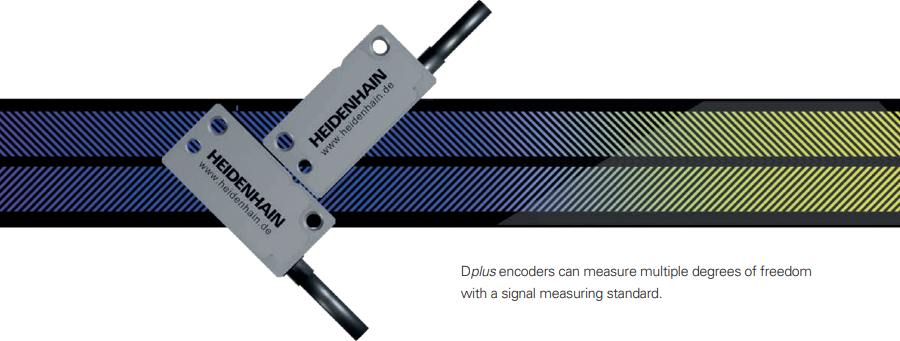 Measuring multiple degrees of freedomA body in space can move along six possible axes. These are divided into translational degrees of freedom (X, Y, Z) and rotational degrees of freedom (RX, RY, RZ). Normally, measuring multiple degrees of freedom requires numerous components. Standard encoders require one scanning head and one measuring standard for each degree of freedom. The Dplus encoders from HEIDENHAIN, however, can significantly reduce the number of components required. A Dplus scale with two separate graduation tracks and three scanning heads on the same scale, for example, can measure up to three degrees of freedom. This technology makes it possible to implement complex measuring tasks in a simple and compact design. Measuring multiple degrees of freedomA body in space can move along six possible axes. These are divided into translational degrees of freedom (X, Y, Z) and rotational degrees of freedom (RX, RY, RZ). Normally, measuring multiple degrees of freedom requires numerous components. Standard encoders require one scanning head and one measuring standard for each degree of freedom. The Dplus encoders from HEIDENHAIN, however, can significantly reduce the number of components required. A Dplus scale with two separate graduation tracks and three scanning heads on the same scale, for example, can measure up to three degrees of freedom. This technology makes it possible to implement complex measuring tasks in a simple and compact design.For more information, please contact us 
|